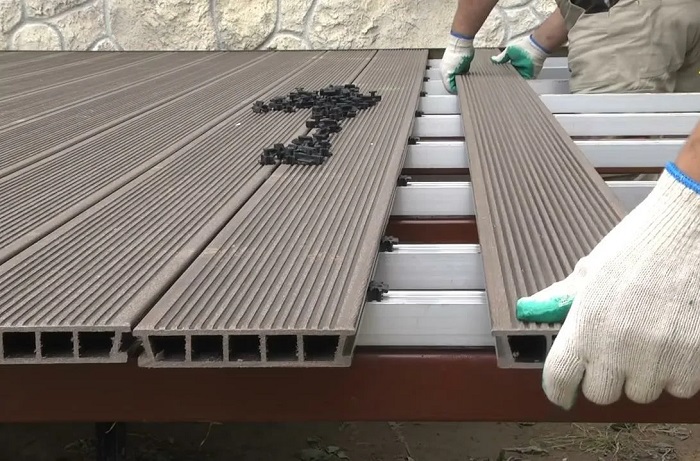
A decking terrace is a practical solution for creating a relaxation area near a home, cottage, or pool. The material is valued for its resistance to moisture and temperature fluctuations, durability, non-slip surface, and easy maintenance, as well as its neat appearance that lasts for years. When choosing, it’s important to consider the decking type, load class, and component compatibility to ensure the decking provides reliable performance under any operating conditions.
Proper installation begins with preparing the base and precise markings: joists are installed on a level support with proper spacing, ventilation gaps and correct temperature compensation are ensured, and fasteners are selected for the specific installation system.
How to Choose a Decking Material Based on Climate and Load
Choosing a decking material begins with assessing the climate: temperature fluctuations, humidity, precipitation, sun intensity, and the length of the freezing season directly affect the stability of the deck’s geometry and durability. The higher the humidity and the more severe the freeze-thaw cycles, the more important the deck’s resistance to swelling, cracking, and slippage, as well as the material’s ability to maintain its appearance without frequent maintenance.
The second key factor is load: frequency of foot traffic, the presence of furniture, barbecues, planters, and point loads from chair and table legs. High-traffic areas and commercial spaces typically require greater strength, dimensional stability, and predictable long-term performance, while a private terrace can emphasize tactility and naturalness, provided it’s prepared for regular maintenance.
WPC, Larch, and Thermowood: Which is Better in Specific Conditions?
WPC (wood-polymer composite) is often chosen where predictability and minimal maintenance are important: the material is moisture-resistant and doesn’t require annual oiling in the usual manner for wood. For regions with frequent rainfall, dampness, proximity to bodies of water, and heavy use, WPC is convenient because it doesn’t warp as noticeably as untreated wood and maintains its shape when installed correctly, including proper clearances, ventilation, and fasteners. For heavy traffic, it makes sense to choose a board with sufficient thickness and density, and keep in mind that darker shades heat up more in the sun and may be less comfortable for barefoot use.
Larch is an option for those who want natural wood with good natural durability but are prepared to regularly protect the surface. In moderate climates, larch performs well, but in high humidity and sudden temperature fluctuations, it is critical to ensure adequate ventilation under the decking, proper clearances, and edge protection; otherwise, the risk of cracks and warping increases. Larch is suitable for areas with high traffic, but requires disciplined maintenance: regular oil/impregnation updates, especially in open, sunny areas, where fading and drying out occur more quickly.
Thermo-modified wood (thermally modified wood) often offers a compromise between naturalness and stability. Heat treatment reduces moisture absorption and improves dimensional stability, which is beneficial in climates with fluctuating humidity and temperatures. However, thermally modified wood remains wood: it still requires UV protection to preserve its color and reduce surface aging, especially on south-facing and open terraces. Thermally modified wood performs well in residential projects and areas with regular use, but when choosing for high-traffic areas, it’s important to consider the base species and the manufacturer’s recommended joist spacing and fastening method.
- Damp and rainy climates, proximity to water: WPC or thermally modified wood are often preferred, provided proper floor ventilation is provided.
- Severe temperature fluctuations and freeze-thaw cycles: Stable materials (WPC/thermowood) are preferred, with particularly careful installation with expansion gaps.
- For the most natural look and feel: larch or thermally modified wood, but with regular maintenance and UV protection in mind.
- High traffic and furniture with point loads: High-strength WPC or properly selected thermally modified wood, taking into account joist spacing and quality. foundation.
Practical guidelines for selection and connection to installation
For the material to «open up,» it must be selected in conjunction with the deck structure. For WPC, it is important to provide expansion gaps and proper fasteners (often branded clips), as well as a level base and ventilation – this reduces the risk of «waves» and maintains stability. For larch and thermowood, edge protection, water drainage, a ventilated subfloor, and correct gaps between boards are critical: the wood must be able to safely Compensate for seasonal changes.
If minimal maintenance is a priority, choose wood-plastic composite (WPC) on https://enva-construction.com/our-services/patio-covers-seattle/; if you want a natural deck and are prepared to regularly refinish it, choose larch; if you want wood with a more stable geometry for harsh climates, choose thermally modified wood. In any case, the end result depends not only on the material but also on adherence to installation guidelines: a stable base, ventilation, drainage, and fasteners recommended by the manufacturer of the specific board.