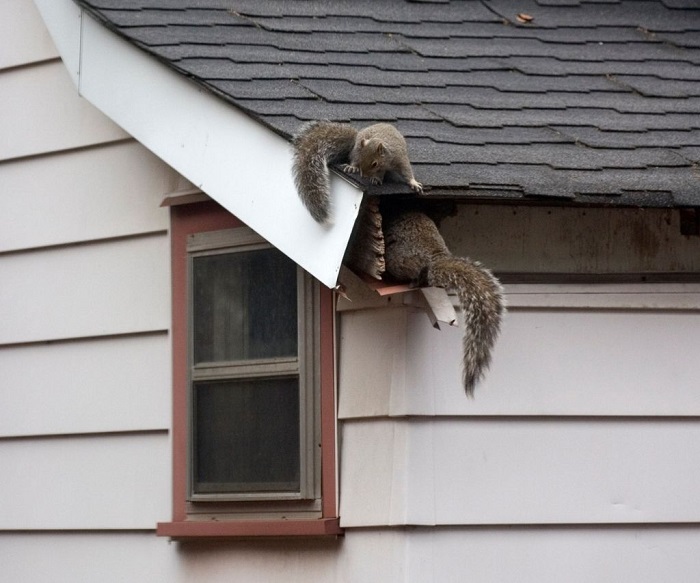
Squirrels easily find weak spots on the roof: cornice vents, blowouts and gaps in the under-roof space. Penetrating inside, they damage the insulation and vapor barrier, gnaw wiring and wood, create noise and carry debris, which over time increases the risk of leaks and fire hazards.
To prevent re-entry, it is important to combine inspection of the roof, removal of cracks, and installation of mechanical barriers on ventilation units without disrupting air exchange. The practice of squirrel-proofing roof vents helps to keep ventilation functioning and at the same time close access to rodents, extending the life of the roof cake and reducing repair costs.
Diagnostics of penetration routes: inspection of overhangs, ends and abutment areas
The diagnosis of penetration routes begins with a careful circumvention of the perimeter of the roof and an assessment of the places where squirrels most often find access to the under-roof space: overhangs, cornice vents, endowments and abutment areas. It is important to record not only obvious damage, but also indirect signs of activity – displacement of elements, local gaps and traces of regular contact with materials.
It is more convenient to carry out the inspection in good lighting, moving from cornices to complex nodes. Special attention is paid to areas where the structure has drops, joints and «pockets» – it is there that cracks form, which eventually increase from wind load and seasonal deformations, creating entrances to the insulation and ventilation ducts.
The overhangs and cornice are checked for the integrity of the lining, the tightness of the slats and the presence of technological gaps at the ends. Frequent «weak points» are loosely fixed spotlights, deformed edges, gaps at the windshield and areas around the cornice vents. Any signs of gnawing, scuffing and «fluffed» edges of plastic / wood indicate attempts to expand the passage and require clarification of the actual width of the gap along the entire length of the node.
Checking the ends and abutment areas
The endowments are inspected as a zone of increased water load and accumulation of debris: leaves and branches can retain moisture, accelerating corrosion and destruction of sealing, as well as mask gaps at the edges. It is important to check the evenness of the carpet / slats, the absence of detachments and points where fasteners or the edge of the coating form a «step» for which the animal can cling and pull itself up.
The abutment zones (to walls, pipes, attic superstructures) are diagnosed for breaks in waterproofing and leaks in aprons, abutment strips and seals. Signs of problems often include microcracks in the sealant, bending of the edge of the strip, cracks at corners and transitions, as well as «soft» places where the seal has sagged. To avoid hidden passages, it is useful to check the node sequentially along the contour, noting the areas where the gap repeats and forms a continuous path to the cornice ventilation or under-roof cavities.
- Look for traces: nibbles, scratches, dirt scuffs, remnants of insulation, nutshells near the node.
- Check the geometry: shifting spotlights, bent slats, parted joints and «walking» panels.
- Mark the routes: support points (gutter, crate, ledges) and places where it is convenient for the squirrel to linger before entering.