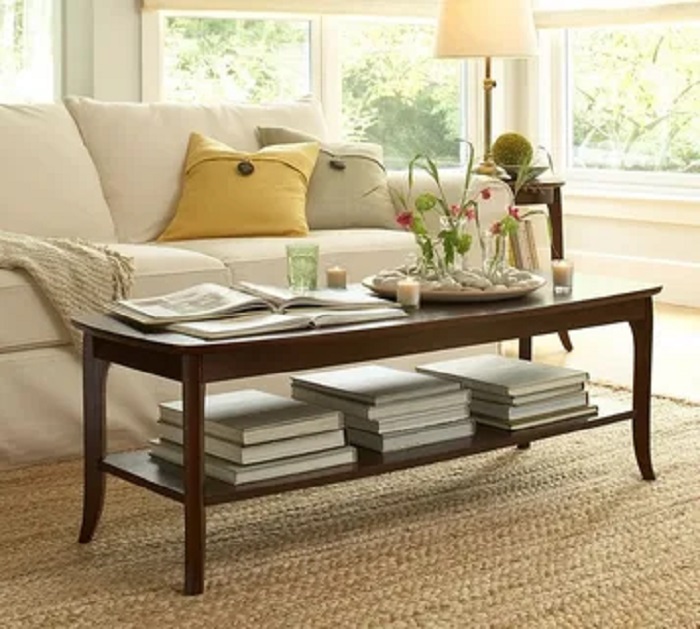
Furnishing a small living room is not about fitting everything in, but about making every piece work harder. A coffee table often becomes the most contested item, balancing practicality, movement, and visual space all at once.
What most guides miss is that the wrong coffee table does not just take up space, it actively disrupts flow, light, and usability. If you are deciding on layout first, understanding what shape coffee table is best for small spaces and layout flow helps frame every decision that follows.
Why is choosing the right coffee table critical in a small living room
A coffee table defines how space is used and navigated, influencing movement flow, visual balance, and how comfortably a room functions on a daily basis.
In small rooms, circulation space becomes more important than furniture size alone. A poorly chosen table can create friction points where people naturally walk, making the room feel cramped even if dimensions technically fit.
Designers often think in terms of negative space rather than furniture placement. The gaps between objects determine how spacious a room feels.
How should size and proportion be calculated correctly
A coffee table should be proportionally aligned to surrounding furniture, typically around two-thirds of the sofa length, while maintaining enough clearance space to allow comfortable movement around it.
The commonly recommended clearance is 30 to 45 centimetres between the table and seating. Less than this restricts movement, while more reduces usability.
However, proportion is not purely mathematical. Visual weight matters equally. A bulky table can feel oversized even when measurements suggest it fits correctly.
Why does shape have a bigger impact than size
The shape of a coffee table controls how space flows around it, affecting both movement efficiency and how visually open or restrictive a small room feels.
Rounded and oval shapes reduce hard edges, allowing smoother movement paths and reducing visual interruption. This is particularly important in narrow or awkward layouts.
Rectangular tables can work, but only when aligned carefully with seating. Otherwise, they tend to create dead zones where space becomes unusable. For deeper design context, principles like spatial layout and flow in interior design and visual perception in spatial environments explain why curved forms feel less intrusive.
What makes a coffee table practical in a small space
A practical coffee table combines multiple functions such as storage, surface use, and sometimes seating, ensuring it contributes more than a single-purpose piece of furniture.
In small living rooms, single-function furniture is inefficient. Storage coffee tables reduce the need for additional units, while lift-top designs can double as workspaces.
The key insight is that practicality should not add bulk. Hidden functionality is more valuable than visible complexity in compact environments.
Why do legged designs make rooms feel bigger
Coffee tables with visible legs create a sense of openness by allowing light and sightlines to pass underneath, reducing visual density within the room.
This effect is often underestimated. When the floor remains visible beneath furniture, the brain perceives more available space.
Solid block designs interrupt this continuity, making the room feel heavier and more enclosed. This is a visual trick rather than a physical one, but it has a strong psychological impact on how space is experienced.
How do nesting tables improve flexibility
Nesting tables provide expandable surface space without permanently increasing the footprint, allowing rooms to adapt dynamically to different uses such as entertaining or everyday living.
This flexibility is particularly valuable in small homes where furniture must adapt to changing needs. The ability to extend and retract usable space prevents overcrowding while maintaining practicality.
From a design perspective, they also reduce commitment to a fixed layout, which can be restrictive in compact spaces.
When is an ottoman a better choice than a coffee table
An ottoman can replace a traditional coffee table by offering a softer, multifunctional surface that can be used for seating, storage, or as a table when paired with a tray.
Ottomans introduce softness into a room, both visually and physically. This reduces the harshness of hard surfaces and improves comfort in smaller spaces.
They are particularly effective in family or casual living rooms where flexibility and comfort are prioritised over formal structure.
How does style influence perceived space
The style of a coffee table affects how visually heavy or light it appears, influencing whether a room feels open and cohesive or cluttered and disjointed.
Minimalist designs with clean lines and lighter materials tend to recede into the background, allowing the room to feel larger.
In contrast, overly detailed or dark, heavy materials draw attention and can dominate the space. The goal is not to make the table invisible, but to ensure it does not compete with the room itself.
Conclusion
Choosing the right coffee table for a small living room is not about finding the smallest option, but about selecting the one that works best with movement, proportion, and visual balance.
The most effective designs are those that respect space rather than fill it. Whether through shape, function, or visual weight, the right coffee table enhances how a room feels as much as how it functions.
When done correctly, it becomes less of a focal point and more of a seamless part of the living environment.