Modern church services often depend on visual presentation. Worship lyrics need to be displayed clearly, Bible passages should be available at the right moment, announcements may require images or videos, and the congregation should always know what is happening next. Managing all these elements does not necessarily require expensive or complicated presentation software.
WorshipScreen is a free, browser-based church presentation solution created specifically for worship services. It combines worship songs, Bible verses, sermon materials, images, videos, backgrounds, and a service timer in one practical workspace. Because the software works through a web browser, there is no desktop application that needs to be installed. A church can prepare its visual content in advance and control the presentation from a computer, tablet, or smartphone.
For churches searching for free worship software, WorshipScreen provides a simple way to organize the visual side of a service without building every presentation from scratch.
What Is WorshipScreen?
WorshipScreen is church presentation software designed around the real workflow of a worship team. Instead of using one program for song lyrics, another for Bible verses, and additional tools for videos or countdowns, the main elements of a service can be prepared in one browser-based environment.
The platform includes several key sections:
- Songs for displaying worship lyrics
- Bible for preparing and presenting Scripture
- Slides for images, announcements, and other media
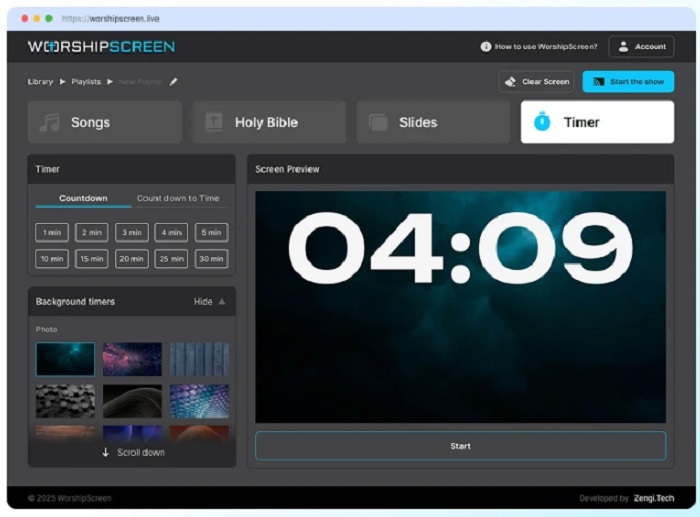
- Timer for countdowns before a service or during transitions
This makes WorshipScreen a universal visual presentation tool for churches of different sizes. A small congregation with one volunteer operating the screen can use the same basic workflow as a larger church with a dedicated media team.
The service is particularly useful because preparation and live control are connected. A presentation can be planned before the service, but the operator can still respond to unexpected changes while the service is taking place. Songs and Bible passages can be added or edited when necessary, which is important because worship services do not always follow the original plan exactly.
Why Use Browser-Based Church Presentation Software?
Traditional presentation software can require installation, configuration, updates, and significant technical knowledge. WorshipScreen takes a different approach: the service is accessed through a web browser.
This makes the initial setup straightforward. A church needs an account, an internet connection, and a compatible display such as a projector, television, or LED screen. The operator can then prepare content and start the presentation from the browser.
Another advantage is flexibility. WorshipScreen can be controlled from a computer or mobile device, while the presentation itself can be shown on a separate screen. With an appropriate setup, a television with a browser can also be used as the presentation display.
For volunteers, this approach can reduce the amount of technical work required before each service.
How to Use WorshipScreen for a Church Service
The most effective way to use WorshipScreen is to prepare the service as a complete visual workflow rather than treating it as a simple lyric projector.
1. Create Your WorshipScreen Account
The first step is to create an account and open the WorshipScreen dashboard. Since the platform is browser-based, there is no need to install traditional desktop presentation software.
Before creating your first service, it is useful to configure the basic visual appearance. You can adjust elements such as fonts, text color, alignment, positioning, and the default background.
The goal should be readability. Worship lyrics and Scripture need to be visible from the back of the church, so visual decoration should never make the text difficult to read.
2. Build a Church Song Library
One of the most useful features is the song library.
Instead of recreating the same worship songs every Sunday, a church can create its own collection. Add a song, enter the lyrics, organize the sections, and save it. The song can then be reused in future service playlists.
WorshipScreen can automatically help divide lyrics into slides, but it is still important to review the result manually. A line break that looks technically correct may not match the way the song is actually performed.
For example, a chorus may be repeated several times, a bridge may be added, or a verse may be skipped. The presentation should follow the actual arrangement used by the worship team.
Keeping slides short and readable is also important. The congregation should be able to recognize the next phrase quickly rather than trying to read a large block of text.
3. Add Bible Verses for the Sermon
Bible presentation is another important part of WorshipScreen.
Before the service, the operator can add the Bible passages expected to be used during the sermon. The appropriate Bible translation can be selected when Scripture is added to the playlist.
For example, if the sermon is expected to reference John 3:16, Psalm 23, and Romans 8:28, these passages can be prepared beforehand. During the sermon, the operator can move through the prepared verses using the available controls.
However, preparation does not prevent flexibility. If the pastor unexpectedly refers to another passage, the operator can add a new Bible verse while the presentation is running.
This combination of advance preparation and live editing is especially useful in real church services, where the order of a sermon or worship set may change.
4. Use Images, Videos and Announcements
A church presentation is not limited to songs and Bible verses.
WorshipScreen can also be used to display images, announcements, uploaded videos, and YouTube content. This allows the media operator to keep different types of visual material within the same general workflow.
For example, a Sunday service could include:
- A countdown before the service
- A welcome screen
- Three worship songs
- An announcement graphic
- A short church video
- Bible passages for the sermon
- A closing slide
Instead of switching between several unrelated programs, the operator can prepare these materials as part of the service presentation.
Videos should always be tested before the congregation arrives, particularly when the presentation depends on an internet connection or online video content.
5. Choose Backgrounds for Worship Lyrics
Visual backgrounds can make worship presentations more attractive, but they should always support readability.
WorshipScreen allows churches to use images, uploaded videos, and YouTube videos as backgrounds. A background can be associated with a specific song, allowing the same visual style to be reused whenever that song appears in another playlist. A common background can also be used for a broader service theme.
A consistent visual identity is usually easier for the congregation to follow than constantly changing backgrounds.
The most important principle is simple: people come to worship and participate, not to study complicated presentation graphics. The background should support the lyrics rather than compete with them.
6. Create a Playlist for Each Service
Once the song library and media are ready, create a playlist for the upcoming service.
A playlist can contain the materials needed for that particular occasion. Give it a clear name, such as “Sunday Worship – September 20” or “Youth Service – September 25.” Clear naming becomes increasingly useful as more services are stored in the account.
Prepare the songs in their expected performance order and add the Bible passages that will probably be needed during the sermon.
It is also worth checking the beginning and end of every song. Make sure there are no missing choruses, incorrect lyrics, spelling mistakes, or inappropriate backgrounds.
The playlist should be considered a working plan. It provides structure while still allowing the operator to make changes during the service.
7. Set Up the Screen or Projector
WorshipScreen can work with a projector, television, or LED display.
One common setup is a laptop connected to the projector or screen using HDMI. When possible, using an extended desktop rather than simple screen mirroring is helpful. The operator can then keep the WorshipScreen controls on the laptop while the congregation sees only the presentation.
Another option is using a compatible TV with a built-in web browser. The presentation can be opened directly on the TV while another device is used for control.
The exact hardware configuration depends on the church’s equipment, but the principle remains the same: separate the control interface from what the congregation sees.
8. Control the Presentation From a Phone or Tablet
Because WorshipScreen is browser-based, mobile control can also be practical.
A phone or tablet can be used to access the service and control the presentation. This can be particularly useful for smaller churches where the worship leader, pastor, or volunteer may need to operate the presentation without sitting behind a dedicated computer.
For example, an operator can remain near the worship team while changing lyrics, Bible verses, or other presentation content.
This flexibility makes WorshipScreen suitable for different church environments rather than requiring one fixed technical workstation.
9. Use the Timer Before the Service
The timer is a simple feature that can make the beginning of a service more organized.
A church can display a countdown for a set number of minutes or count down toward a specific start time. A background image or video can be used behind the timer.
For example, a five-minute countdown can let people know that the service will begin soon. A countdown to a fixed time can be useful when the church has a scheduled starting time.
The timer can also be useful during transitions, provided the visual design remains clear and easy to read.
10. Prepare Everything Before Going Live
Good church presentation is largely about preparation.
Before people enter the building, run through the complete service on the actual display. Do not rely only on how the presentation looks on the operator’s laptop.
Check the following:
- Are all songs in the correct order?
- Are the lyrics complete?
- Are the slides readable from the back of the room?
- Is the correct Bible translation selected?
- Are the required Scripture passages ready?
- Do videos play correctly?
- Are images displayed correctly?
- Is the timer configured properly?
- Are the backgrounds appropriate?
- Does the presentation connection work?
- Is the default screen ready for transitions?
Testing the complete setup can prevent small technical problems from becoming distractions during worship.
11. Keep Transitions Clean
A professional-looking church presentation is not only about showing the right content. It is also about knowing when to remove content.
When a song finishes, the last lyric does not always need to remain on the screen while the worship team leaves the stage. The same applies between Bible passages, announcements, prayer, and sermons.
WorshipScreen provides a default background that can be displayed when no active content is needed. A church logo, welcome image, or simple background can create a clean visual pause.
This small detail can make the entire service feel more organized.
12. Follow the Music Instead of the Software
During worship, the presentation operator should follow the worship team rather than simply clicking through slides at a fixed speed.
The next lyric should normally appear shortly before the congregation needs to sing it. If the slide changes too late, people may already have reached the next phrase. If it changes too early, the congregation may become uncertain about where the song currently is.
The operator should therefore become familiar with the song arrangement before the service.
Rehearsal is particularly useful for new songs. The worship team and presentation operator can agree on repeats, bridges, endings, and transitions before the congregation arrives.
13. Be Prepared for Unexpected Changes
No church service is completely predictable.
A worship leader may decide to repeat a chorus. A pastor may mention a Bible verse that was not included in the original plan. An announcement may be changed at the last moment.
WorshipScreen is designed to provide flexibility in these situations. Songs and Scripture can be added or edited while the presentation is being managed.
However, live editing should be a backup rather than the normal preparation method. The more material that is prepared beforehand, the easier it is for the operator to concentrate on what is happening in the room.
WorshipScreen as a Universal Church Visual Tool
The main advantage of WorshipScreen is that it brings several common church presentation tasks into one browser-based environment.
It can serve as:
- Worship lyrics software
- Bible verse presentation software
- Sermon presentation software
- Church announcement software
- Countdown software
- Media presentation software
- A simple visual control system for worship teams
This makes it a practical option for churches that want one straightforward tool instead of a complicated collection of applications.
The platform is also suitable for multilingual services. Song lyrics and Bible passages can be displayed in two languages, which can help international congregations and churches where members speak different languages. When using bilingual content, the amount of text on each slide should be kept limited so that both languages remain readable.
WorshipScreen for Different Christian Denominations
The workflow is not limited to one particular denomination. Baptist, Methodist, Presbyterian, Pentecostal, Lutheran, Anglican, Catholic, independent, and other Christian congregations can adapt the presentation to their own service structure.
For a church looking specifically for methodist worship software, WorshipScreen can provide the same practical functions required for a Methodist worship service: displaying hymns or worship lyrics, presenting Scripture, showing announcements, supporting sermon materials, and managing visual transitions.
The important point is not the denomination but the structure of the service. Any congregation that uses a screen, projector, TV, or LED display can organize its visual materials through the same basic workflow.
A Simple Weekly Workflow
After the first setup, a church can turn WorshipScreen into a repeatable weekly routine.
Start by updating the song library if a new song is being introduced. Create the playlist for the upcoming service, add the songs in order, prepare the Bible passages, upload announcements and media, and configure the timer.
Then perform a complete technical check on the actual screen. Make sure the internet connection is stable and all videos work. Finally, open the presentation before the service begins and keep the control interface separate from the congregation’s display.
This workflow reduces last-minute preparation and gives volunteers a clear sequence of tasks.
Why WorshipScreen Can Be a Practical Choice for Churches
Church presentation technology should serve the worship service rather than become the center of attention. A good presentation system helps people see the lyrics, follow Scripture, understand announcements, and stay connected with the service.
WorshipScreen focuses on these practical needs. It is browser-based, does not require traditional desktop installation, supports songs and Scripture, handles images and videos, includes a timer, and allows churches to build reusable libraries and playlists. The service is available free of charge, with optional donations supporting further development.
For churches that want a straightforward and flexible visual presentation system, this approach can reduce technical complexity while keeping the essential tools in one place.
Conclusion
WorshipScreen is more than a tool for projecting song lyrics. It can function as a complete visual workspace for a church service, bringing worship songs, Bible passages, sermon content, announcements, images, videos, backgrounds, and timers together in one browser-based platform.
The most effective workflow is simple: prepare the content in advance, create a playlist, test the presentation on the real display, and then use the software during the service to follow what is happening in the room.
Because the platform is free, browser-based, and designed with church volunteers in mind, it can be used by congregations that need a practical presentation solution without investing in complex professional software.
For worship teams, pastors, volunteers, and church media ministries, WorshipScreen provides a unified way to organize what the congregation sees — from the first countdown before the service to the final Scripture or worship song.